GET STUFF DONE

A community resource to help people simply get stuff done, where we can share our successes and encourage others to have positive results. Please note though we're not trained wellbeing therapists. We're just like you, trying to make ourselves happier, healthier and calmer one day at a time, sharing what we have learned so far.

  • Why You Need a Dream

    Have you ever felt like you were just going through the motions? Waking up, working, coming home, sleeping, only to rinse and repeat the very next day? If so, you’re not alone. Many people find themselves in this cycle, waiting and hoping that something better will eventually come along. But without a dream goal to guide you, life can start to feel like you’re drifting along without direction…It’s never too late to identify a dream.

    A dream goal acts like a compass. It gives your daily actions purpose and meaning. Instead of working just to pay bills or meet deadlines, you’re working towards something that excites you. And no, your dream goal doesn’t have to be about making a fortune or climbing the corporate ladder. It could be something simple yet powerful, something like writing a book, travelling the world, starting a community garden, or just living a life that feels truly yours. The key is that it brings you fulfilment.

    That sense of excitement can transform your mindset, making even the most ordinary tasks feel like important steps on a grand adventure. When you have a dream, you’re no longer on the side lines in your own life. You’re actively shaping and creating your future. That dream becomes your fuel, your reason to keep going when things get difficult, and your secret weapon when motivation is running low.

    It also helps you see your current work situation in a new light. Maybe it’s not your dream job, and that’s okay. But perhaps it’s teaching you valuable skills, helping you meet interesting people, or building up the resilience you didn’t know you had. Every experience counts when you know where you’re heading.

    Some people don’t need a dream, or they land their dream job without even realising until they start work, it does happen, but not very often. Without a dream, there’s a risk of spending your life building castles in the air for someone else. You might feel that all the work you are doing is just making others (your boss) better off, without creating a pathway for yourself to a more fulfilled and happier life. By identifying and committing to your dream goal, you take back the steering wheel, the accelerator and control of the sat nav. Do we even need the brakes?

    Do you know what your dream is?
    If not, have a little think, what gets you genuinely excited? What kind of life makes you smile when you imagine it? If you’re unsure, start by asking yourself what you loved doing as a child, what topics you lose time exploring, or what kind of work feels more like play. Consider who you admire and why, there might be clues to your dream hidden in what you see in others.

    Here’s a quick checklist to get the grey matter ticking:
    ✔ What do you do when you’re supposed to be doing something else?
    ✔ What topic could you talk about for hours without checking your phone?
    ✔ What’s something you’ve always wanted to try but never dared?
    ✔ Who are the people you admire – and why?

    Imaging you have already reached your dream.
    Once you have an idea, try this: close your eyes and imagine you’ve already achieved your dream. Really picture it. Where are you? What are you doing? Who’s around you? Now, travel back through time imagining what were the key moments and decisions that got you there? What skills did you learn? What habits did you build? What risks did you take? Imagining a dream already achieved can make it seem more reachable, because you have already completed it mentally you can easily go back through those steps to see what you did to get there.

    Lets be honest though, not everyone can drop everything and chase a dream full-time. You’ve got responsibilities, bills, kids, pets, and probably a long list of household chores and DIY jobs you haven’t finished yet. But dream-building doesn’t have to be dramatic. It can start with ten minutes a day. Reading a blog post (like this one), jotting down ideas, or finally signing up for that evening class. Baby steps count.

    So, tonight, today….even right now, do something small but powerful. Write down one sentence that describes your dream life. Stick it on your fridge, your mirror, your desk. That’s your step one….If you’re brave enough feel free to write it down in the comments below.

    The best bit really is that once you have a dream, and identified at least some of the steps you need to take to get there, you won’t struggle for motivation. Even small progress will give you a sense of satisfaction. Motivation will become your supporter, reminding you that you’re on your way to somewhere amazing in your life.

  • Welcome to the Get Stuff Done reset kit, a gentle way to restart your goals and mindset. We all fall off track sometimes and that’s completely normal. This kit isn’t about doing more or being perfect. It’s about meeting yourself where you are and taking the next small step with intention.

    Whether you’re picking up a goal you paused, shifting your focus, or just needing a reset after a hectic week, this space is for you.

    Take your time. Use what feels helpful. Come back whenever you need it.

    You’ve got this.

    1. The “Fallen Off? Start Here” Checklist

    (tick off as you go)

    🔲 I have forgiven myself for not being perfect.
    🔲 I have revisited why I set this goal in the first place.
    🔲 I have picked one small action I can take today.
    🔲 I have written a gentle reminder: “Progress, not perfection.”
    🔲 I am ready to start again, imperfectly but intentionally.


    2. Weekly Mini Planner

    (copy this page for each week you want to use it)

    This week’s focus:
    👉 Write your simple intention or goal here.

    Key Actions (3 max):

    • No. 1 –
    • No. 2 –
    • No. 3 –

    One thing I am letting go of this week:
    👉

    One thing I am excited about:
    👉


    3. Reflection Prompts

    (use these any time you feel stuck or unsure)

    • What is working well right now, even if it feels small?
    • What needs adjusting with kindness (not criticism)?
    • What would “simpler, not harder” look like for me today?

    4. Quick Calm: A Grounding Exercise

    When you feel overwhelmed:
    Stop. Breathe in slowly for a count of 4, hold for 4, exhale for 6.
    Repeat 3 times.
    Then ask yourself:
    👉 “What is one small thing I can do next?”


    📌 Notes and Ideas:

    (space for brain dumps, plans, or journaling as needed)

    Download this Get Stuff Done Reset Kit here as an editable Google Doc, feel free to share it with as many people as you can. DOWNLOAD NOW

  • As you may know if you have read previous posts on here, I’m not an author who is writing well-being posts from scratch, I’m simply on my own well-being journey and sharing information I have come across, either from books or podcast that I have found really useful.

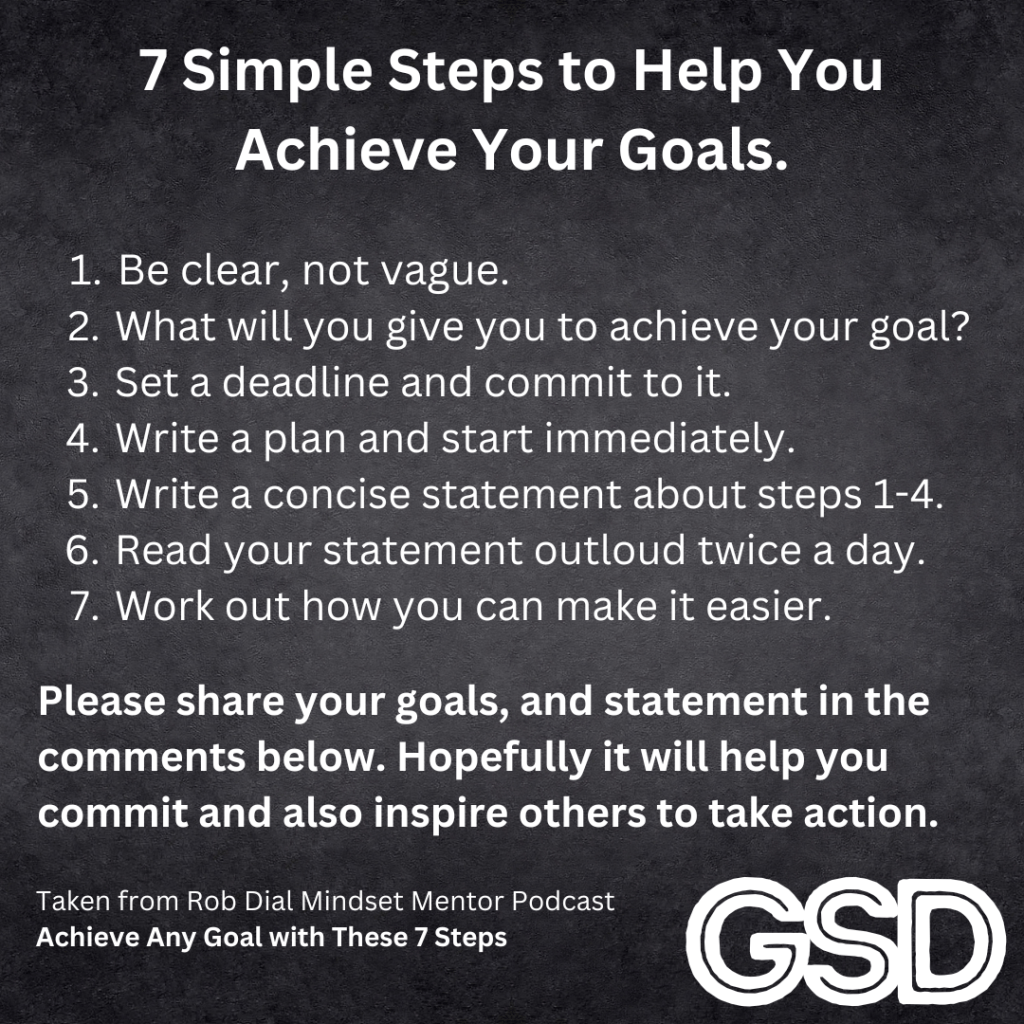
    I recently listened to an episode from The Mindset Mentor that really helped reframe how I think about goal setting. Rob Dial talks about seven simple steps to achieve any goal in a more human and manageable way.


    1. Be crystal clear about what you want

    This isn’t just about writing a goal down – it’s about making it specific and simple. If a six-year-old couldn’t understand your goal and explain it to another six-year-old, it’s not clear enough.

    Saying “I want to lose some weight” is vague. Saying “I want to lose 1 stone, weigh 12 stone and reach 15% body fat by December” is something you can actually visualise and work towards.


    2. Decide what you’re willing to give up

    This step really stood out. To make space for something new, something old has to go. Rob puts it bluntly: your old self has to die off for the new self to emerge.

    That might mean giving up alcohol at weekends, cutting out sweets or saying no to late nights so you can wake up early. Every yes has a corresponding no.


    3. Set a real deadline

    A goal without a date is just a nice idea. A deadline adds focus and urgency.

    So instead of “I want to start running again,” it becomes “I want to run a 10K by 1st August”. When there’s a date on the calendar, your brain starts to take it seriously.


    4. Write a plan and start straight away

    No more “I’ll start Monday” energy. The moment you know what you want, create a plan and take action immediately – even if it’s just a small step.

    Rob shared a trick for when you feel stuck or overwhelmed: write from the perspective of your future self. Imagine it’s already happened and journal what you did to make it happen. It helps unlock creative ideas without the pressure of needing the ‘perfect’ plan.


    5. Turn your goal into a short statement

    This is where it starts to come together. Write a brief statement that includes the key points from steps 1 to 4.

    Keep it short, no essays. Try and keep it to 3–5 sentences and definitely no more than 10. Something you can read in less than a minute that reminds you of exactly what you’re working towards and how you’ll get there.


    6. Read it out loud – morning and night

    It might feel awkward at first (especially if someone walks in), but this is about reinforcing your focus daily.

    In the morning, your brain is in a state that’s more open to suggestion – like kids absorbing the world around them. In the evening, your subconscious is active as you fall asleep. Reading your goal aloud at both times helps lock it into your thinking and keeps it front of mind.


    7. Ask: “How can I make this easier?”

    We often assume success has to be a struggle, but what if it didn’t?

    By asking how you can make things simpler, you shift into problem-solving mode rather than stress mode. Maybe success could feel lighter, even enjoyable. It’s worth asking.


    A few examples Rob shared

    These brought the steps to life for me:

    • Weight loss: “I will lose 20 pounds by 31st December. I’ll stop drinking, cut out sweets, and work out 4 times a week. I’ll meal prep every Sunday and Thursday.”
    • Work goals: “I’ll earn £250,000 this year. I’ll stop checking social media during work and focus on 100 calls a day. I’ll follow up every Friday.”
    • Mental health: “I’ll reduce anxiety by 1st November. I’ll give up caffeine and stressful relationships. I’ll meditate each morning, journal gratitude and pause every 3 hours for deep breaths.”

    Final thoughts

    If you follow these steps consistently, you’re not just setting goals – you’re reprogramming your belief in what’s possible. You stop hoping things will change and start building the habits that make change inevitable.

    Let me know in the comments if you try this out – I’d love to hear what your statement ends up being.

  • Building Resilience Through Routine: The Not-So-Secret Power of a Bit of Structure

    Let’s face it, we all get caught up in life’s whirlwind from time to time.
    The things we planned to do get pushed aside, we’re distracted by unexpected events, and before we know it, the weekend’s approaching and we haven’t a clue where the week went or what we actually achieved.

    If you find yourself feeling a little overwhelmed, or perhaps a bit disappointed, take heart in the fact that you made it through the week. You’re still here, still showing up, and still battling on. And that’s something to be proud of.

    This blog is going to talk about the often mundane subject of routine. In the middle of all the chaos, there’s something surprisingly powerful in the ordinary.

    Routine can be the unsung hero of our everyday lives. It’s like the dependable friend who always shows up, even when the world feels a bit topsy-turvy.


    So, what is resilience, anyway?

    Resilience is that little voice in your head that helps you carry on after a bad start to the day, a stressful week, or one of those “why does this shit keep happening” days.

    It’s a quiet strength from within that encourages you to push through the painful moments to find the balance again.

    Resilience can be built. Just like muscles get stronger with movement, your emotional resilience grows when you have little anchors in your day that keep you on track or just making sure you set off on the right foot.


    Routine, a calm place in the storm

    A simple routine can be a huge tool in helping you build resilience, here’s why:

    • Predictability feels safe – When life is throwing a wobbly, knowing what’s coming next (even if it’s just your morning cuppa and a scribble in your journal) can be reassuring.
    • Less decisions, more energy – Every decision we make uses up energy, a morning full of decision making can drain us, routine reduces that. If you’ve already decided how your morning looks, that’s one less thing your brain has to mess about with.
    • Start the every day with small wins – There’s something satisfying about ticking off a habit. Whether it’s a walk, a stretch, writing in your journal, or making your bed, it tells your brain, “This day has started well and I’m doing OK.”

    Simple routines that build strength, without dragging your arse to the gym.

    Your routine doesn’t have to feel like a military operation. A few simple tasks that if done often enough will become a habit and you won’t even notice you’re doing them:

    • Consistent wake-up time – Even on weekends, having a sleep in every now again again doesn’t hurt though.
    • Hydration first thing – Before the tea or coffee, have some water. Your body will thank you.
    • Five-minute journal check-in – How am I feeling today? What do I need? What went well?
    • Fresh air once a day – Yes, even if it’s raining. Especially if it’s raining.

    And remember, resilience isn’t about never falling over, it’s about having a soft place to land. A bit of structure in your day helps create that.


    Stuck in a bit of a rut, just start with small steps.

    You don’t need to change your entire lifestyle over-night. Just choose one item or task that feels manageable. It could be laying your clothes out the night before, making your bed every morning or taking three deep breaths before checking your phone in the morning, better still not checking your phone at all first thing in a morning…that’s a routine that requires you to actually do less!

    The aim isn’t perfection, it’s progress. Routines aren’t set in stone; they’re scaffolding helping you build something. They give your mind a bit of breathing room so you can cope, adapt, and even thrive.

    Remember, habits are formed through repetition. For an action or task to become a habit it is said that it can take on average 66 days…so don’t get disillusioned if you have the odd slip up, just keep going.


    Need a Little Help Getting Started?

    If you’re thinking, “I love the idea of a routine, but I can’t seem to stick to one,” you’re not alone, hopefully we have just the thing for you.

    Take a look at the Get Stuff Done Goal Tracker Journal – designed to help you build better habits, one page at a time.

    It’s a simple, no-fuss tool to track your goals, reflect on your wins, and keep you focused on what matters most. Whether you’re trying to drink more water, carve out me-time, or just feel a bit more put-together, this journal can help you stay on track without the overwhelming you.


    Final Thought (and a gentle nudge)

    Routine isn’t about squeezing the joy out of life, it’s about making space for that joy. When you’ve got a bit of rhythm in your day, everything else feels just a little bit more manageable.

    So this week, why not try adding one tiny thing to your routine? Something that fulfils that sense of achievement, make it doable, and just for you. Then sit back, take a look at what you did, did it make your day or week feel a tiny bit better already?

    And if you fancy a companion to keep you going, the Goal Tracker Journal is ready when you are. Let’s build resilience, one small habit at a time.

    One last tip – Sometimes we need to be accountable to make these changes, tell someone what you’re doing and ask if they’ll check up on how you’re getting on. Or feel free to comment on here so the get stuff done community can help and support you. We also have a Facebook page where you can comment and post your targets or achievements.

    ps. As an extra incentive, the first 10 people who comment on here with one of their goals will receive a free Get Stuff Done Goal Tracker & Journal.

  • We’re delighted at Get Stuff Done to publish our first ever post written by a guest. Oliver Harsley is quite well know in Hull for being a local contributor to grass roots football teams, engaging regularly on LinkedIn and being a program contributor for Hull City AFC. I reached out to Oliver to see if he would write a post on his challenges and how he manages his own mental health and autism.

    I’ve always been keen to ensure that I keep on top of my mental health. Most of the time, I’m quite successful with this as I feel very happy with how my life is going and I’m satisfied with what I do within my various voluntary endeavours. There have been some instances where I‘ve lamented my lack of full-time employment and overall place within the world.

    The latter mindset only manifests itself on a sporadic basis. This is placated and eventually dissipates away through keeping myself focused on what I enjoy doing. Ever since discovering a love of writing, this has played a huge part in giving me a real sense of purpose in life and a great way to express my thoughts and feelings. I always have a good feeling whenever I write as it sparks my creativity and keeps my mind occupied.

    As a teenager, I struggled to comprehend my mind and how it worked. I wasn’t able to grasp how to deal with certain emotions such as anger and frustration. It led me to have some down periods where I really didn’t feel like I was going to achieve anything with my life. I used to compare myself to other people and then brought myself down due to not doing stuff that they were doing. This only made it even worse for my mental state.

    However, I was able to overcome this malaise through the fantastic support of my family and close friends. They helped me realise that I was valued and had a lot to give when afforded the opportunity to showcase what I was capable of. Over the years, I’ve had the pleasure of being a volunteer in local non-league football which has put me in contact with lots of wonderful people. It’s had a transformative effect on my ability to speak to people and the confidence I have within myself as a person.

    That’s not to say that there haven’t been occasional wobbles during that time. I’m guilty of overreacting to small and trivial things and then making them out to be so much bigger than they actually are. It brings me down and sucks all the happiness out of me when it happens as I become so angry with myself for even reacting in that way. Thankfully, it doesn’t occur that much because I’ve worked on taking everything that comes with more thought before suddenly going into a full blown rage.

    As of now, I’m in a very good place with my mental health. I’ve grown so much as a person since my teens when I was someone who was lost and didn’t properly know who they were. I had to wait until I was 16 before I received an official Autism diagnosis. After doing so, I made it my mission to not let it prevent me from being able to achieve anything that I want to do. It’s definitely been an interesting and challenging experience thus far, but I wouldn’t change anything because it helped shape the person I am today.

    Oliver Harsley.

    I also asked Oliver what techniques he uses when he’s feeling a bit down, what works for him to raise his spirit?

    It’s a bit cliché, but basically listening to music that I really like or watching a favourite film to just zone out and be in a place of comfort

    Thank you so much Oliver for contributing such a valuable post. Oliver wouldn’t take payment for writing this post, instead he asked if we could make a donation to The National Autistic Society, which we are doing. If you would like to make a donation to such a worthwhile charity then please follow this link https://www.autism.org.uk/get-involved/donate

  • Oi you, yea you!

    I have no idea what kind of day you’re having so far, perhaps you’re smashing it, but maybe you’re just managing to drag yourself through it by your coat strings. Either way, I want to say something that we all forget way too often:

    You’re doing better than you think.

    No honestly, you are. Just by the simple fact that you dragged your backside out of bed and got up. You made a start and then kept going. Also, you’re reading this instead of scrolling mindlessly (well… slightly less mindlessly). That must count for something, it must mean you’re exploring ways to help yourself and that’s amazing.

    So here’s the deal:

    • That thing you’re stressing about? Try not to, the future you will figure it out and deal with it. And if you don’t, in six months you probably won’t even remember this “thing” you’re currently stressing about.
    • That person you keep comparing yourself to? They’re probably comparing themselves to someone else right now. Focus on yourself and be happy you are where you are, remember, there’s no time like the present to change the future.
    • And that little voice in your head being a bit of a dick? It likes to talk doesn’t it, sometimes we just have to tell it to pipe down so that we can focus on what we want to think and do. You’re in control of that voice. Let it have it’s 30 seconds than tell it to be quiet and that your in control.

    Take a breath. Wiggle your toes. Unclench your jaw (you’re doing it now, aren’t you?).

    You don’t need to have all your shit together right now. You just need to keep showing up, messy, tired, uncertain… but still trying. Remember we only fail when we give up and stop trying.

    You’re brave to get up, you’re brave to make a start, you’re brave to keep going…in actual fact you’re totally smashing today!

    So go drink some water, eat something that’s not beige, go for a brisk walk and remind yourself: You’ve got this. Even if it doesn’t feel like it.

    💬 Tell me—what’s something you’ve done today that deserves a tiny high five? Drop it in the comments. I’ll go first: I resisted the urge to hit snooze, we’ll I actually did hit snooze (by accident) but I got up at the first alarm and made a start writing this at 6am.

  • Are you a collection of labels you have gained over the years, perhaps labels laid upon you by someone else, a parent, a relative, a friend even an employer.

    As humans we forget we were born with nothing…not even a name, as we grow older we acquire labels, things that are given to us by others or something we have learned or something we have become…stick with it, hopefully it will make sense.

    This post is a summary of a recent Mindset Mentor podcast by Rob Dial, you can listen to it here. Rob starts this podcast recalling a story he once heard, It’s about a bird flying through the sky, feeling free and graceful. One day, the bird spots a beautiful lake below and decides to land. The water is calm, peaceful, and inviting, and the bird finds it so soothing that it stays a bit longer than intended. Eventually, the bird stays so long it forgets it can forgets it can fly and starts to identify with the water, thinking it’s just part of the lake. When the water gets choppy, the bird struggles and fears it might drown, trying to control the state of the lake instead of remembering that it could just fly away at any time.

    This story is a metaphor for the human condition, which is our tendency to try to control things we can’t, whether it’s our circumstances or our inner thoughts. We often forget that we are the observer behind our thoughts, not the thoughts themselves. For example, try this: silently think the word “happiness.” Now, who said it? Who heard it? You said it in your head, but did you also hear it? This shows that you are the consciousness behind your thoughts, and the silent observer.

    When we are born, we have no labels, no identity. We’re not a mother, a wife, or a worker. These are things we pick up along the way. We forget that we are more than our thoughts, our names, or the roles we play. Just like the bird is not the water, we are not our minds. Yet, we often get so caught up in our thoughts, emotions, and labels that we think that is who we are. But we are the consciousness behind it all, the silent witness.

    We struggle when our minds get loud and chaotic, like the bird struggling in choppy waters. We try to control our thoughts, but it’s like trying to smooth out water with an iron. You can’t force your mind to be silent. The best thing you can do is to let it be. Just as the bird can fly away from the lake, we can distance ourselves from our thoughts. Instead of fighting the mind, let the thoughts come and go. When we stop resisting, the mind naturally calms down.

    The natural state of your mind is calm, like a quiet lake. Sure, storms happen, and life gets messy, but just like a hurricane, those storms will pass. When you accept your thoughts and emotions as they are, without trying to control them, they lose their power over you. The next time your mind feels like a storm, just step back and breathe. Allow the thoughts and feelings to be there, and they’ll eventually pass, just like clouds drifting away.

    So, remember: You are not your thoughts. You can fly away anytime you choose.

    This really was a brief summary of the Mindset Mentor podcast, make sure you listen to the full 17 minutes <<LISTEN NOW>>

    affirmations anxiety Autism autumn burnout cup of coffee cup of tea depression dream big dream life exhaustion fatigue get stuff done goals goal setting goalsetting goal tracking happiness health journal journaling life manifestation manifesting meditation mental-health mental reset mindfulness mindset morning routine Motivation personal-development personal-growth planning resilience routine self-belief self-care self-improvement Self Confidence stuckinarut well-being wellbeing wellness writing

  • It might not be because of a lack of sleep.

    This YouTube video by the Rob Dial of The Mindset Mentor, explains the different factors that can cause us to feel overwhelmingly tired and completely drain our energy reserves.
    Please watch the video, we started watching these and listening to the Mindset Mentor podcasts and it has been really beneficial to our own mental health and understanding where we can find our motivation from within.

    In summary though if you don’t have time to watch the video:
    1. Mental Fatigue – Constant decision making consumes energy, the average person makes an unbelievable 35,000 decisions a day. The worlds best chess players can burn 6,000 calories a day just by playing chess.

    2. Emotional Exhaustion – Too much worry, too much stress, too much fear. Emotional burnout can leave you feeling tired. Are spending more time concerned with pleasing other people then taking care of yourself.

    3. A Lack of Purpose – This too can be draining, plodding through life not knowing what your goals are can be soul destroying. Humans need a purpose to thrive, whether that’s self development or adding value somewhere else. Take time to find something your passionate about and indulge in that whether it’s a hobby, a new class or even a new job.

    4. Are you constantly on edge – Our nervous system was designed to help keep us safe and some people permanently live in fight or flight mode. You need to learn to simply chill out. Go for a walk, get out in nature, sit in a quiet place with no distractions for a while. You don’t have to be 100% production 100% of the time. It’s OK to relax and chill.

    Please listen to the podcast or watch the YouTube video above which will give you a far greater insight into why you may be exhausted this than this brief summary can do.

    Again comments below would be really appreciated, as we’re trying to build a community that helps each other become happier!

    Don’t forget, if you would like to start goal tracking setting or journaling than the Get Stuff Done Goal Tracker Journal is ideal and can be bought from Amazon for just £6.98 <<BUY NOW>>

  • This might be a bit controversial, but it’s worth thinking about. The ideas in the image only scratch the surface, but they come from a powerful lesson shared by Rob Dial on The Mindset Mentor podcast.

    Rob explains how the things we’re told as children often become ingrained in our minds, so much so that they shape our identity without us even realising it. Imagine these beliefs as a shirt you were handed as a child. You’ve worn it for years without questioning if it even fits anymore. It’s old, faded, and completely out of sync with who you really are. But because it’s always been there, you’ve never thought to take it off.

    The Power of Words We Carry

    A child who’s repeatedly told they’re ugly may carry that belief into adulthood, no matter how untrue it is. That belief quietly dictates their actions, making them shrink in social settings, avoid eye contact, and doubt themselves. It’s not reality, it’s just an outdated, hand-me-down belief they never challenged.

    And here’s the real kick in the proverbials: You’re still wearing the dirty shirt someone else put on you. But only you can take it off.

    Want more confidence? Start telling yourself you are confident. Want to feel attractive? Look in the mirror and tell yourself you are good-looking. It might feel silly at first, but the way you see yourself is exactly how others will start to see you too.

    Breaking Free from the Lies You Were Told

    Maybe you grew up hearing that obesity “runs in your family.” Sure, genetics play a role, but often, it’s habits, not heredity that get passed down. It might not be that obesity runs in your family, but the fact that no one runs in your family. (Yeah, dad joke…sorry!)

    I get it. I’ve been a landscape gardener for a few years, always on my feet, always moving and carrying things and yet, I carry extra weight. Why? Because I love biscuits and sweets, and I eat more than my three sons combined. That habit? It no doubt started in childhood, where there was always a stash of treats in the house. And now, I’ve carried it into adulthood. Can I break that cycle? Probably but, I’m dreading it….perhaps if I commit to it on here it has more chance of becoming reality.

    But I’ve seen first hand how small changes can make a huge difference. I know people who started taking daily walks, no gym fees, no expensive equipment, just a walk. And they lost over a stone, 6.3kg or 14lb. More importantly, they felt better. Small steps lead to big shifts.

    The Lies About Intelligence

    Ever been told you’re “just not smart”? Maybe someone said you were terrible at maths, and you believed them. But here’s the truth: That’s utter bollocks.

    You were conditioned to think that way. Maybe you had a bad teacher. Maybe you weren’t taught in a way that made sense for you. But being bad at something once doesn’t mean you’re doomed forever. Want to be better at maths? You can be. Take an online course. Go to a class. Challenge that belief.

    When I was about 7 or 8, my teacher stopped an assembly rehearsal, made me sing alone in front of the entire class, and then told everyone I was ruining the song because I was out of tune. I had to mime for the rest of the performance, think that’s called lip-syncing now!

    Did that moment define my life? No. But to this day, I only sing in public if I’ve had a few drinks first. And who knows, maybe I could sing if I ever bothered to learn…this isn’t isn’t a commitment to start singing lessons.

    Confidence Isn’t About Looks, It’s About Belief

    We’ve all seen that person. The one who walks into a room and commands attention, not because they’re the best-looking, the tallest, or the smartest, but because they own who they are. They believe in themselves, and that energy is contagious.

    And here’s the good news: Nothing is stopping you from having that kind of self-belief.

    So take off the old, ill-fitting shirt, the one someone else gave you years ago. Put on the confident, good-looking, capable shirt. Say it, believe it, live it. And watch how the world responds.

    Now, I’d love to hear from you, have you broken free from an old belief that was holding you back? Drop a comment and share your experience.

    P.S. Yeah, I only got a C in GCSE English, so my writing isn’t perfect. There might be the odd typo, but just like confidence, improvement takes practice.

  • One step at a time…start with a simple to do list, nothing too big, something small and achievable. Setting goals that are too big or too difficult to achieve, especially as your first ones could demoralise you before you even get started. In the early days take the small goals and gradually work up to the bigger, dream ones.

    Small goals can be as simple as:
    1. Get up early – this enables you to get something done before you go to work, starting the day in a positive way.
    2. 10 minutes reading each day – regular reading improves brain power and memory function. Try some wellbeing books or coaching books that can help you improve confidence and motivation. One we really like is S.U.M.O. by Paul McGee.
    3. Take a brisk walk, even a short 15 minute walk will contribute to your general wellbeing.
    4. Learn something new…get that brain energised.

    It’s time to get stuff done, make a commitment, share your to do list and keep us updated on your progress.

    Don’t forget not to get too hung up on something you don’t manage to get completed, but keep working on it until it is done.