GET STUFF DONE

A community resource to help people simply get stuff done, where we can share our successes and encourage others to have positive results. Please note though we're not trained wellbeing therapists. We're just like you, trying to make ourselves happier, healthier and calmer one day at a time, sharing what we have learned so far.

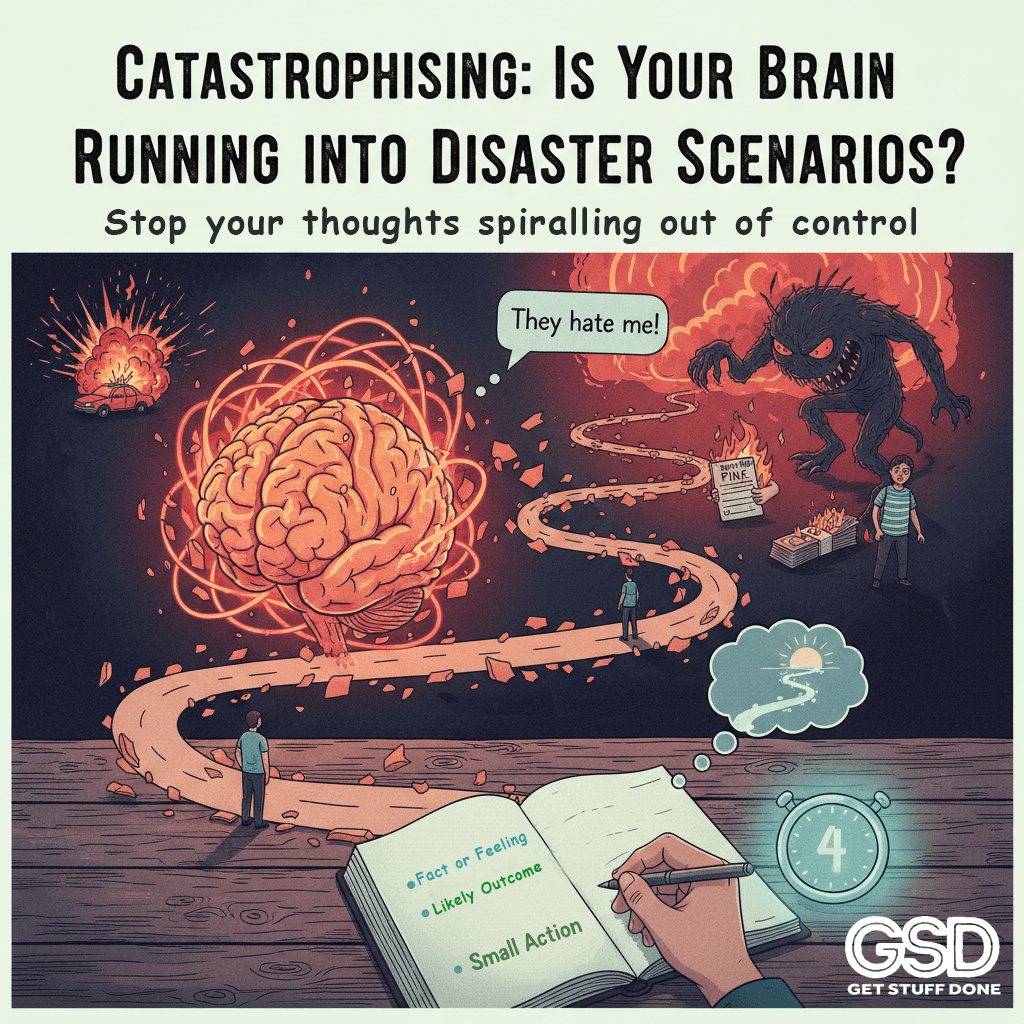
  • Stop your thoughts spiralling out of control over something that hasn’t even happened… and probably won’t.


    Catastrophising – It sounds dramatic because it is.

    It’s when your brain gets hold of a situation, it’s usually small and harmless, but your brain ends up running full speed into an imaginary disaster.

    It’s not always rational. But it is very convincing.


    What Is Catastrophising?

    It’s your brain trying to protect you.
    It scans for danger, fills in the blanks, and cooks up every possible outcome…just in case.

    But the problem?
    It’s terrible at knowing when to stop.

    Before you know it, one tiny trigger becomes an epic disaster movie in your head. Your focus is gone, your motivation has vanished, and that calm, productive person has left the building.


    The “Greatest Hits” of Catastrophising

    • “That B@5tard just cut in – we nearly crashed”
    • “They haven’t texted back — I must have upset them.”
    • “I made a mistake at work — I’m going to get sacked.”
    • “That payment is late — I’ll never financially recover.”
    • “I feel off today — what if it’s something serious?”
    • “I can’t do this task — clearly I’m failing at everything.”

    Sound familiar?

    Here are a few real-life examples:

    A car cuts you up on the road and your brain immediately imagines the crash, the argument, the roadside showdown.
    In reality? You both just drive off. Nothing happens.

    An email goes unanswered and now you’re convinced they hate your work, they’ve always disliked you, and they’re probably preparing your P45.
    In reality? They’re just busy. You’ll get a reply when they have a moment.


    What Helps: Write It Down (Yes, Really)

    If your thoughts are spiralling, journaling helps get them out of your head and into the light, where they usually look far less dramatic.

    Here’s a quick way to unpick the panic:

    1. Write down exactly what your brain is shouting.
    2. Ask yourself: is this a fact, or just a feeling?
    3. What’s the most likely outcome…not the worst one?
    4. What’s one small action I can take?
    5. And if there’s nothing to do right now? That’s useful to know too.

    Try the 4–4–4 Breathing Technique

    When you’re mid-spiral, the first step is to get out of your head and back into your body.

    This quick breathing technique is simple but powerful:

    1. Breathe in for 4 seconds
    2. Hold it for 4 seconds
    3. Breathe out for 4 seconds
    4. Repeat a few times

    This calms your nervous system and brings your brain back to the here and now, instead of that fictional disaster zone it’s trying to live in.

    This was a technique I learned From EK Psychotherapies when did some CBT work with them.


    Final Thought

    Catastrophising isn’t weakness. It’s your brain trying to stay safe.

    But most of the time? There’s no impending disaster.
    Just a runaway thought train that needs a gentle brake.

    So next time you feel your mind strapping on its boxing gloves or reaching for the big red panic button Pause. Breathe. Write.

    And if you can make a habit of writing those thoughts down regularly, you’ll start to train your brain to respond you would like it to, not just react on a whim.


    Need a place to offload the noise in your head?
    The Get Stuff Done Journal is built for real people, real thoughts, and real life…warts and all.

    Below is an image from one of our first Social Media posts back in February 2025 – can’t believe this is our first blog on this subject!

  • A season of joy… and juggling.


    We all know the Christmas story: joy, laughter, festive cheer, family, friendship, and enough fairy lights to be seen from space.

    But let’s be honest, for many of us, the reality feels a little bit different.

    Christmas can also bring stress, financial pressure, emotional overload and, for some, a sharp sense of loneliness.


    🎁 The Magic (and Shift) of Christmas

    Most of us carry fond memories from childhood, lots of presents under the tree, family meals, pantomimes, and the sacred ritual of daily chocolate from the advent calendar (if you were lucky).

    Then things shift.

    Your late teens and twenties? Probably more about nights out, questionable Secret Santa gifts, and trying not to embarrass yourself too much at the work do. (Spoiler: it still happens in your when you’re supposed to be older and wiser.)

    As we get older, the pressure creeps in and some years, it feels overwhelming.


    Where Does the Pressure Come From?

    Honestly? Everywhere. A few usual suspects:

    • Money worries — presents, food, travel, time off work
    • Keeping up appearances — from your tree to your roast potatoes cooked in goose fat
    • End-of-year work panic — wrapping up projects and chasing clients before the break
    • Social expectations — either too many invites… or none at all
    • Trying to do it all — and make it all look effortless

    Everyone else seems to have their act together, shopping sorted by Halloween, with price tags that would dent Elon Musk’s pocket and an entertaining budget worthy of a royal banquet. Meanwhile, you’re wondering how to stretch what’s left in your account, still buy crackers that actually crack and have enough left over to make it through to January’s payday.


    Gifts & Food

    You don’t need to remortgage to show people you care.
    A thoughtful card or a small, meaningful gift goes a long way, especially when it comes from the heart and not just the middle aisle at Lidl.

    And food?
    It doesn’t need to be goose-fat potatoes, three meats and seventeen sides. You don’t have to produce a five-course tasting menu. It’s a meal, a special one, yes, but still just a moment to sit, eat and chat with the people you care about.


    The Work Pile-Up

    December is a juggling act of festive panic:

    • Clients want things signed off before they vanish
    • Projects pile up
    • Enquiries go quiet just when you were counting on them
    • And for the self employed there’s a couple of weeks at least where people don’t want any work doing.

    It’s exhausting. And that’s before you even try to start relaxing.


    All the Invitations… or None

    Some of us are juggling more invites than we can say yes to. Others quietly close the office door on Christmas Eve and might not see anyone again until the New Year.

    Neither situation is easy. One drains your energy. The other can chip away at your spirit.

    If you’re swamped: say no where you need to.
    If you’re alone: there are options — local events, community dinners, and online groups that welcome company over Christmas.


    A Little Reminder

    Christmas doesn’t have to be perfect. It doesn’t need to be expensive.
    It’s allowed to be quiet. It’s allowed to be messy. It’s allowed to be yours.

    And if you’re feeling the weight of it all, remember you’re not alone.


    🎄 Gentle Ideas for a Simpler Christmas

    • Keep your gift list small (and your expectations smaller)
    • Choose one or two invites and give yourself permission to leave early
    • Don’t try to finish the year in a blaze of productivity glory
    • Take the pressure off your plate, literally and figuratively
    • Check in on someone who might be struggling
    • Say no. Say yes. Say “maybe” until you’re sure.

    Christmas is different for everyone.
    Let it be what you need it to be this year.

    And if in doubt, pop on a paper crown, eat something that involves chocolate or cheese, and take five quiet minutes for yourself.

    You deserve that much and more.

  • (And How to Actually Use One Without the Pressure)

    So, you’ve got yourself a shiny new productivity journal.
    You crack open the first page, grab a pen, and… suddenly feel like you’re meant to be reinventing your life before lunch.

    Sound familiar?

    The truth is: journals are a brilliant tool, but only when used like they were meant to be. Not as some kind of high-performance bootcamp or test of your handwriting. Just a simple place to sort your thoughts and take back control of your day.

    Here are 3 common mistakes people make with productivity journals and some tips on how to avoid them.


    1. Trying to “do it properly” from Day One

    We understand, you want to use your journal right. You spend half an hour setting it up like a work of art, only to despair when your priorities change the next day.

    Productivity journals aren’t meant to be perfect.
    They’re meant to be used. Scribbled in. Crossed out. Folded. Flipped back through. Picked up and put down again.

    Our Tip:
    Start small. One page. One day. One simple focus.
    And if it looks a bit chaotic? That means it’s working.


    2. Feeling like you’ve failed if you miss a day (or three)

    Let’s be honest: life gets in the way of good habits, no matter how much determination we have.
    You have a busy week. You forget. You drop the habit. Suddenly the journal is sitting in the corner, sending you on a guilt trip every time you glance across at it.

    Here’s the secret: you can pick it up again at any time.
    There are no journal police. No marks deducted. No wasted pages. Just you, if you need it to help for just a few complicated days, or a tricky month that’s fine. In a perfect world we would use it every day but in real life there are not many that can maintain that discipline… We’re not saying don’t try and get in to the great habit of using it daily, what we’re saying is don’t stress about it.

    Especially with our own Get Stuff Done Journal, there are no dates. You can dip in and out whenever you need a reset.

    Our Tip:
    Just turn the page. Start fresh. It’s still there for you, it never needed to be perfect in the first place.


    3. Over-planning instead of taking action

    Ah, the productivity trap: spending more time planning the work than actually doing the work.

    It feels productive (colour-coded tasks! fresh bullet points!), but you haven’t actually kicked the ball yet.

    Journals work best when they support your day, not replace it.

    Our Tip:

    • Keep it simple.
    • Write your top 3 priorities.
    • Choose one small win.
      Then close the journal and crack on.

    Use the journal to guide your actions, not distract from them.


    Final Thought

    Your journal isn’t a piece of art.
    It’s a tool. A companion. A place to brain-dump. And, yes, it can be bit of a sanity-saver.

    You don’t need to “use it right”. You just need to use it your way.
    Messy, sporadic, scribbly just like real life.

    And honestly? That’s where the magic is.


    👉 Ready to try a journal that doesn’t judge or pressure?
    Explore the Get Stuff Done Journal undated, flexible, and always ready when you are.

  • Starting something new feels brilliant, doesn’t it?
    You’ve got fresh notebooks, big ideas, a fresh playlist, and huge “new chapter” energy. Everything feels exciting…until it doesn’t.

    One morning, you wake up, or perhaps one evening when you get home from your day job, the energy isn’t there. The magic, excitement, buzz has gone. Your shiny new project, hobby, job, or goal now feels suspiciously like the dull, monotonous work you were hoping to leave behind. Perhaps boredom is starting to creep in.

    So how do you keep going when the novelty fades and the routine sets in?


    1. Accept That It’s Normal

    First off, believe it or not this happens to a lot of people. New jobs, hobbies, projects and even relationships have that dip in energy levels and interest. The brain loves novelty, but once the sparkles fade, you’re left with the slightly less glamorous stuff: the repetition.

    Don’t panic. The dip doesn’t mean you’re failing. It means you’ve moved past the honeymoon phase and into the part where real exciting growth can happen if you just stick at it.


    2. Shift From Excitement to Curiosity

    When excitement fades, curiosity is your best friend. Instead of chasing constant motivation, start asking:

    • What could I do differently today?
      A different approach, or a new way of doing a previous task could reignite that spark.
    • What can I learn from this?
      Learning, keeps your brain motivated. Even a short lesson learned can lift the energy levels.
    • What can I do to make something more of a challenge?
      Something too easy can be really hard to do.

    Curiosity turns routine into exploration and that’s a great way to keep your brain engaged in a project, hobby or even a job.


    3. Find Tiny Wins in the Familiar

    Find small wins and rituals that make the process enjoyable again. It’s not about fireworks, it’s about keeping those embers glowing.

    • It could be a dose of fresh air, either in a morning before you start or when you get in from your day job to lift those energy levels. A 5 to 10 minute walk around the block can do the trick.
    • Put your favourite tracks on, the ones that give you an immediate lift in mood.
    • Maybe it’s the satisfaction of ticking one box off on your to-do list.

    4. Revisit Your “Why”

    When things get dull, it’s easy to forget why you started.
    Take five minutes to reconnect with your original reason. Write it down. Stick it somewhere visible.

    “I’m doing this because I want to feel proud of myself.”
    “I’m learning this skill because it will open new doors.”
    “I’m doing this because I want to change the direction I was heading in”

    A reminder of your purpose can reignite the motivation that’s slipped quietly out the back door.


    5. Give Yourself Permission to Evolve

    Sometimes we lose interest because we’ve changed or grown. What excited you six months ago might not fit anymore and you know what, that’s okay.
    Adjust your goals. Refresh your plan. Let the next version of you take the lead.


    Final Thought 💭

    The novelty might fade, but your progress doesn’t have to.
    Keep showing up, stay curious, and let your motivation shift from sparkly and new to steady and grounded.

    You don’t need constant fireworks, you just need just enough glowing embers to see the next step.

  • Bonfire Night isn’t just about fireworks, sparklers and loud bangs. It’s a great reminder that sometimes you’ve got to let things burn.

    Not necessarily literally, but burning stuff mentally can really help us move on from something that may be holding us back. OK, for those firebugs, if it’s safe to do so than burning stuff literally can help too! (we’re not recommending pyromania here).

    We all carry stuff that drags us down. Whether that’s old habits, mistakes, or that nagging little “what if” voice that pipes up at 3am. So tonight, why not toss those into the flames?

    Let it go (safely)

    Grab a bit of paper and write down one thing you’re ready to let go of. Something that doesn’t serve you anymore. Then safely burn it, shred it, or simply rip it to bits. Watch it go. Feel that release.

    You’re not erasing the past; you’re acknowledging it, learning from it, and choosing to move forward lighter and freer.

    Make it meaningful

    Bonfire Night is the perfect backdrop for a little emotional house-cleaning. The fire crackles, the night sparkles, and you get to say: I’m done carrying that.

    It’s a small ritual, but small rituals often make the biggest difference to your well-being.

    So, what are you ready to burn away? And what new spark are you going to light instead?


    #GetStuffDone #Wellbeing #BonfireNight #FreshStart #MindfulMoments #mentalhealth

    Write it down in your journal or in the comments below — then let it go.

  • We’ve all had those days when you wake up feeling like you’ve been hit by the No. 10 bus. The coffee kick isn’t delivering, the to-do list looks like a chapter from war and peace and your get up and go, has got up and gone.

    Don’t worry, feeling tired doesn’t have to mean you have lost the day already. It means you just require a few quick wins to help boost your energy naturally and get you back on top, ready to beat the days challenges.

    Overcoming tiredness header image

    1. Drink First, Think Later

    Before you even glance at the kettle, have a glass of water. It sounds basic, but dehydration is one of the biggest hidden causes of tiredness. A big glass of water first thing in the morning can give you a surprisingly fast energy boost, no caffeine required (yet).

    2. Move Something (Even If It’s Just You)

    You don’t have to hit the gym to wake up your body. A quick stretch, a walk round the block, or a cheeky kitchen dance to your favourite song can shake off the sluggishness. Just a few minutes of movement helps increase blood flow and oxygen, which is one of the easiest ways to stop feeling tired during the day.

    3. Get a Breath of Fresh Air

    Open a window or step outside for a few minutes even if it’s just to look at the clouds. Fresh air and natural light tell your brain it’s time to wake up, helping to reset your internal clock and give you a simple, natural energy boost.

    4. Take a Power Nap (Without Falling Into a Coma)

    Sometimes, the only way to fight fatigue is to surrender to it, albeit briefly. A 15–20 minute nap can do wonders for your focus and mood. Just keep it short so you don’t wake up feeling like you’ve travelled half way around the world.

    5. Check Your Sleep Routine

    If you’re constantly wondering why you’re always tired, it might be time to look at your bedtime habits. Keep a regular sleep schedule, dim the lights, and ditch your phone before bed. A proper night’s rest is the ultimate energy booster and doesn’t cost a penny.

    6. Snack Smart

    When your energy dips, it’s tempting to grab something sweet. But sugar highs are followed by huge crashes. Go for snacks that give you sustained energy, fruit, nuts, yoghurt or something with protein. Your body (and no doubt your mood) will thank you later.

    7. Laugh, Chat, or Relax

    Sometimes the best natural energy boost isn’t food or drink it’s connection. A quick chat with a friend or work colleague, a funny video, or even a bit of quiet time to yourself can lift your energy instantly.

    8. Simplify Your Day

    Mental clutter can be just as draining as physical tiredness. If you’re feeling overwhelmed, write down everything on your mind, then focus on one small task. Getting even one thing done gives you a quick hit of motivation and a boost of energy to keep going.

    Summary

    Overcoming tiredness doesn’t mean overhauling your life it’s about little resets that make a big difference. Drink your water, move a bit, get outside, and rest when you need to. You don’t need to run on empty to be productive sometimes, the best way to get stuff done is to take a moment to stop and recharge.

  • Learning isn’t just about going to school or night class or sitting exams and taking online courses; it’s a powerful, accessible form of self-care. It increases confidence, builds social connections, and can help give you some focus whilst taking your mind off things that may be making you anxious.

    We have done some of the leg work for you too, by adding a downloadable PDF at the bottom of this blog with 50 Ideas to Learn Something New Today to help get you started!

    1. The Confidence Catalyst (It’s Not About Being Brilliant) 💪

    • The Problem: When we feel stuck in a rut, our confidence can sag. Starting something new can feel daunting, leading to perfection paralysis. You become scared of doing something new because you have told yourself you won’t be able to do it to the standards you want to.
    • The Solution: The boost comes from the process, not the mastery. Embrace the “beginner brain.” That feeling of small, daily progress (your “One Small Win” concept!) releases dopamine, reinforcing the belief that you can learn and adapt.
    • Practical Tip: Don’t aim to be a pro. Aim to be 1% better than you were yesterday. Learn three phrases in a new language, watch the first five minutes of a complex tutorial or learn something about the history of your local neighbourhood or town.

    2. The Focus Fixer (Bye-Bye, Brain Fog!) 🧠

    • The Science (Simplified): Learning forces your brain to create new neural pathways, essentially giving your mental processor a necessary workout. It’s the ultimate cure for brain fog caused by repetitive, mundane tasks.
    • The GSD Angle: Concentrated learning is the antidote to modern distraction. When you’re focused on figuring out how to play a new chord, figure out a spreadsheet formula, or master a new phrase in a foreign language, you don’t have the capacity to spiral into worry or scroll aimlessly.
    • Practical Tip: Schedule a “Learning Lunch.” Block out 20 minutes of your lunch break to focus solely on learning something new (a health boost tip, a coding snippet, a history fact).

    3. The Sense of Purpose Upgrade (The ‘Why’ Factor) 🧭

    • The Insight: Feeling a sense of purpose is crucial for long-term well-being. Learning something new, even a silly hobby, gives you a clear goal that is owned entirely by you.
    • The Well-being Link: When you have a project (like learning to play a musical instrument or new DIY skills), you shift your mental energy from problems (stress, worry) to progress. It gives you a reason to look forward to tomorrow….unless you’re that person who really shouldn’t attempt DIY.
    • Practical Tip: Define the purpose. Ask yourself: “How will this new skill/knowledge make my life 1% better?” (E.g., “I’ll feel proud,” “I can finally mend that hole,” “I can impress my friends with a new fact.”)

    4. The Social Superpower (Connection Beyond Small Talk) 🤝

    • The Benefit: Learning creates instant social connection. You gain a common ground with others, it may introduce you to new people who can help you move forward.
    • Practical Application: Instead of awkward one-on-one catch-ups, join a class or group based on the skill (e.g., a cooking class, a walking club, an astronomy group). This eliminates the pressure of carrying a conversation and replaces it with a shared activity.
    • Practical Tip: Sign up for an “Intro to…” course (photography, pottery, public speaking). You automatically meet people who are at your level and share your enthusiasm.

    Conclusion: Time to Invest in Your Best Asset

    Learning is the ultimate investment in your mental health. It’s not about finding more time; it’s about making the time you have more meaningful. Grab your journal or notepad, list one thing you’ve always wanted to try, and schedule that first 15-minute learning sprint today!

    It doesn’t have to cost anything either, there are lots of resources and courses online that are free to access.

    Don’t forget to share with us either on our social media pages or in the comments below what you have learnt.

    Short of ideas, download our 50 Ideas to Learn Something New Today sheet, hopefully it will give you a little inspiration.

  • Beyond Bubble Baths: 5 Self-Care Rituals for the Extremely Busy Person

    Let’s be honest, when someone tells you to “practice self-care” and describes a warm bubble bath, a full spa day, or a week-long digital detox, a tiny part of your extremely busy brain probably screams, “I’d love to, but WHEN?!?”

    For those of us juggling a an already crazy life – work, family, second jobs, trying to remember if we fed the dog, the idea of self-care often feels like another item on an already overflowing to-do list. And who needs that stress?

    But here’s the thing: Self-care isn’t a luxury; it’s an essential for helping you to keep going and not become overwhelmed by everything around you. Without it, you’re running on fumes, and eventually, the fatigue will simply get the better of you.

    You need to get rid of the guilt and unrealistic expectations. We’re talking about micro-rituals: small, intentional acts that can recharge your batteries in minutes, not hours.

    Here are 5 self-care rituals for the person who genuinely has very little time (but desperately needs some calm):


    1. The “Power Pause” (3-5 Minutes) ☕

    Forget the 30-minute meditation app if that feels impossible. This is about hitting your internal ‘pause’ button.

    How to do it: Find a quiet spot where you’re unlikely to be disturbed. Set a timer for 3-5 minutes. Close your eyes, take 3 deep breaths, and simply focus on the sensations around you: the hum of the fridge, the distant traffic, the feeling of your feet on the floor. Don’t try to clear your mind; just observe what you notice without judgment.

    Why it works: It breaks the cycle of constantly doing something, offering a tiny reset button for your nervous system. You’d be amazed what a few mindful minutes can do for clarity.


    2. The “Mindful Movement Snack” (5-10 Minutes) 🚶‍♀️

    No time for the gym? No problem. Your body still needs to move to shake off stress and get the blood flowing.

    How to do it: Step outside for a brisk walk around the block. Do 10 minutes of gentle stretches (there’s lots of ideas for stretches on YouTube). Turn up the music and dance to one of your favourite songs. Run up and down your stairs a few times. The key is intentional movement.

    Why it works: Gets stagnant energy moving, boosts mood with endorphins, and offers a physical release for mental tension. Plus, a dose of fresh air or a good tune can work wonders quickly!


    3. The “Journal Jolt” (2-5 Minutes) ✍️

    Your Get Stuff Done Journal (or any Journal or notepad) isn’t just for tasks – it’s a mental gym! You don’t need to write an essay.

    How to do it: Open your journal to a fresh page. Set a timer for 2-5 minutes. Write down the answer to one simple prompt:

    • “What’s one thing I’m grateful for right now?”
    • “What’s the one thing weighing me down the most?” (and then leave it on the page!)
    • “What’s one small win I had today?” (We love small wins!)

    Why it works: It acts as a mental ‘brain dump,’ helping you process emotions, gain perspective, and often, spot solutions you didn’t see when thoughts were swirling around your head chaotically.


    4. The “Sensory Reset” (1-2 Minutes) 👃🌸

    Engage one of your senses fully to pull yourself out of the pressure pot inside your mind and back into the present moment.

    How to do it: Light a favourite candle. Put on that song that instantly lifts your mood (and just listen, don’t multitask!). Enjoy a delicious, guilty pleasure such as your favourite chocolate. Run your hands under cold water. Breathe in the scent of essential oils.

    Why it works: Our senses are powerful anchors to the present. A deliberate sensory input can quickly shift your state and provide a much-needed mental break.


    5. The “Digital Sunset” (15 Minutes Before Bed) 📵

    Ditch technology and create a restful buffer zone before you attempt to go to sleep.

    How to do it: For the last 15 minutes before you intend to sleep, put all screens away. No phone, no tablet, no TV. Read a physical book, listen to some calming music, do your Journal entry, or just sit quietly.

    Why it works: Blue light from screens interferes with melatonin production, making sleep harder. This ritual signals to your brain that it’s time to wind down, leading to better quality rest, which is the ultimate self-care for busy people!


    You are the most important asset in your life and work. Treating yourself with these small acts of kindness isn’t selfish; it’s smart. Pick one or two that you like the sound of and give them a go today. Your brain, your body, and your productivity will thank you!

    What’s your favourite quick self-care ritual? Share it in the comments!

  • Hands up if your brain sometimes feels like that drawer everyone has, you know the one. The “miscellaneous” drawer overflowing with old batteries, cables, chargers, random keys, a tin of old screws, and a stash of receipts from years ago.

    Yep, thought so. Well unfortunately our minds can get just as cluttered, sometimes even more so. We’re constantly bombarded with to-dos, worries, “what ifs,” and a general mental rubbish that builds up, making it hard to find clarity and, well, get stuff done!

    It’s time for a mental spring clean…who cares if it’s autumn! Let’s talk about what to “shred” from your mind today.


    Why Our Brains Become Hoarders

    Our amazing brains are constantly processing information, but they’re not always great at filing or discarding. We pick up emotional baggage, latch onto worries (sometimes worries others have, they’re not even your own), replay conversations, and hold onto commitments we probably shouldn’t.

    This isn’t just annoying; it’s exhausting. Mental clutter saps your energy, dims your focus, and makes even simple decisions feel like climbing Mount Everest in flip-flops.


    The Shredder is Ready: What to Toss!

    Grab your Get Stuff Done Journal (or any bit of paper, we’re not fussy!), and let’s do a quick mental clutter check-in. Ask yourself, what am I carrying around today that I can absolutely, definitively shred?

    Here are some prime candidates for the mental shredder:

    1. The “Should-Haves” & “Could-Haves” 🤦‍♀️

    • “I should have replied to that email faster.”
    • “I could have handled that conversation better yesterday.”
    • “I should be more productive right now.”

    SHRED IT! You can’t change the past. Dwelling on what should or could have been just wastes precious mental energy that you need for what is and what will be. Learn from it, then let it go.

    2. Unfinished & Uncommitted Tasks 📝

    You know those vague ideas floating around? “I should really look into that new hobby,” or “Must remember to tidy the garage sometime.” These half-thoughts are pure clutter.

    SHRED IT! Either commit to it (and put it on a to-do list with a specific action!) or consciously decide not to do it right now. If it’s not a “hell yes,” it’s probably a “no” for now. Giving yourself permission to postpone or discard makes a huge difference.

    3. Other People’s Expectations (That Aren’t Yours) 🎭

    Are you stressing over something because you feel like someone else expects it of you, even if it doesn’t align with your priorities or values?

    SHRED IT! Your life, your rules (mostly!). While we have responsibilities, sometimes we take on burdens that aren’t truly ours, or we overthink what others might be thinking. Focus on what genuinely matters to you. This doesn’t mean be inconsiderate, but try putting yourself first for a change.

    4. The “What Ifs” & Worst-Case Scenarios 🔮

    “What if this goes wrong?” “What if they say no?” “What if the sky falls?” Our brains are brilliant at conjuring up imaginary disasters….catastrophising, we thought we had done a blog on this. Might have to make that the next one!

    SHRED IT! Most “what ifs” never happen. For the ones that might, ask yourself: “Is there anything I can actually do about this right now?” If not, acknowledge the thought, then gently push it away. If there is, turn it into an actionable step, and tackle that small win!

    5. Old Grudges & Minor Annoyances 😤

    That slightly passive-aggressive off the cuff comment from last week. The driver who cut you up this morning. The item you bought two weeks ago now in the 50% off sale. Are you still replaying it?

    SHRED IT! Holding onto these tiny irritations is like carrying around a pocket full of tiny, sharp stones. They just weigh you down and poke at you. Forgive, forget, or simply acknowledge the frustration and consciously release it. You deserve mental peace!


    Your Mental Shredding Machine

    The process is simple:

    1. Acknowledge: Notice the thought or worry.
    2. Identify: Is it one of the shreddable items above?
    3. Decide: Do I need to keep this? Is it serving me? Is it actionable today?
    4. Shred: If not, imagine throwing it into a mental shredder. Vvvvt! Gone!

    Give yourself permission to declutter your mind today. You’ll be amazed how much lighter and clearer you feel. A decluttered mind is a powerful mind, ready to get stuff done!

    What are you shredding from your mind today? Share your thoughts in the comments below.

    Tip: If you find your mind running away with itself stressing or worrying this simple breathing trick will work wonders.
    1. Breathe in whilst counting to four.
    2. Hold your breathe whilst counting to four.
    3. Breathe out whilst counting to four.
    4. Repeat a few times and that irritation or stress will have faded.

  • Hands up if you’ve been here: You set out aiming for a perfect, hugely productive day. We’re talking every task ticked, every email sent, a glorious clean desk, and maybe even having had time to make an appearance at the gym…Then, life happens.

    The kids needed a last-minute lift, the internet went down, or an awkward customer (or even colleague) drains your energy. Suddenly, you’ve skipped your planned workout and your morning focus is long forgotten, it isn’t even a memory anymore, it has just vanished.

    And what do you end up telling yourself? “Well, the day’s ruined now. I might as well just take a look at my social media, potter about or even just give up.”

    That, is the dangerous trap of chasing the Flawless Day Unicorn.


    Ditch the Unicorn (It Doesn’t Exist Anyway)

    The idea of a perfect, glitch-free day is not only exhausting but utterly counterproductive. When we demand perfection, the first tiny wobble makes us feel like total failures, which in turn gives us permission to stop trying altogether. It’s an all-or-nothing mindset that’s pretty much guaranteed to end up in failure or eventually complete burnout.

    Instead, let’s champion a better hero: The One Small Win.


    The Unstoppable Power of a Small Win

    A small win is the tiny, achievable thing that moves your personal or professional life forward, no matter how chaotic the world around you is. It’s a low-stakes victory that gives you a genuine boost of confidence.

    You don’t need a flawless day to have a successful one. You just need to land your one small win.

    So, what counts as a Small Win?

    • Sending that one tricky email you’ve been avoiding for days or even weeks.
    • Completing the first 15 minutes of the huge project you’re dreading.
    • Actually opening your Journal and planning your day (that’s a win in itself, it would be amazing for us if that was the GSD Journal…but any notepad will do!).
    • Having a five-minute stretch instead of sitting glued to your chair.
    • Making a proper cup of tea and enjoying it without multitasking.
    • Clearing the dirty dishes before you got to bed (hello, clear morning!).

    Why This Little Victory is a Big Deal

    The ‘one small win’ is your secret weapon because of three brilliant things it does:

    1. It Kicks Off Momentum 🚀

    Checking off a small win floods your brain with dopamine. That little burst of feel-good juice makes you think, “Hang on, I’m good at this! What’s the next little thing I can conquer?” It flips your day from “failure mode” to “progress mode.”

    2. It’s Failure-Proof 💪

    If the day goes sideways after you’ve achieved your win, you still won! You are not derailed. You went to bed knowing you moved something forward. That’s resilience in action, and it means tomorrow starts on a positive note, not a recovery mission.

    3. It Fosters Consistency 📈

    It’s much easier to be consistent with a low-pressure target. You can hit a ‘one small win’ every single day. And remember: Consistency, not intensity or perfection, is how big goals are truly achieved.


    Your Challenge: Find Your Win

    Forget the unicorn. At the start of your day, look at your list and ask yourself:

    “If I only achieve one single thing today, what will make me feel genuinely good and move me forward?”

    Find that one small win, and do it first. Then, anything else you manage is a wonderful bonus.

    You’ve got this. Now go get that one thing done…and feel free to let us know in the comments below what your small win is going to be (or was if you have already ticked it off) that will make you feel better.